
Peace be upon you, and welcome. How are you? Today I have chosen a different subject, and I hope you enjoy reading it and benefit from it. Science has advanced enormously, and researchers investigate every kind of question. Knowledge spreads around the world, and those who benefit from it and apply it in daily life develop and succeed socially. I do not want to take too much of your time, so let us read today’s selection and what scientists have written about it.
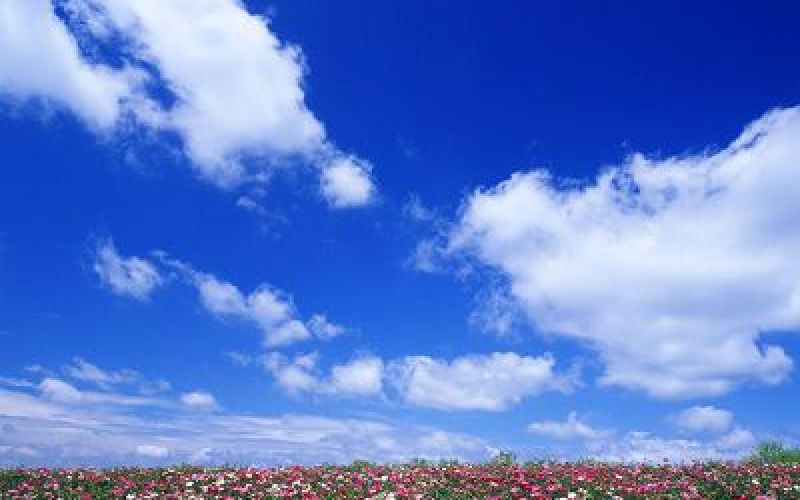
The sky’s color ranges from dark indigo to orange or red at sunset, yet we usually think of its natural color as blue. Since the Sun, Earth’s source of light, emits white light, it is intriguing that we consistently think of the sky as blue.
White light is a mixture of the seven spectrum colors—red, orange, yellow, green, blue, indigo, and violet—as seen in a rainbow. These correspond to different wavelengths of light. The color of visible materials also depends on sunlight’s different wavelengths. Materials can absorb light, reflect it, or refract it in different directions; a completely transparent material lets light pass through unchanged. Human vision also affects what we see.
A red material, for example, absorbs all the spectrum’s colors except red, which it reflects. A purple material reflects some red and some blue. Black absorbs all the colors, while white reflects them all.
The explanation in the source says that a light beam passing through air is refracted to a degree influenced by the amount of surrounding dust. Short blue wavelengths are affected much more than long red wavelengths. On clear days, with little dust and few water droplets, reflection is very limited and the sky appears pale blue. At sunset, when atmospheric dust increases, especially during harvest periods, light scatters more, particularly short blue wavelengths, leaving yellow and red light visible at Earth’s surface.
If Earth were like the Moon, without a surrounding atmosphere, the sky would always look black, both at night and during the day.
Prepared by Engineer Aref Samman.