
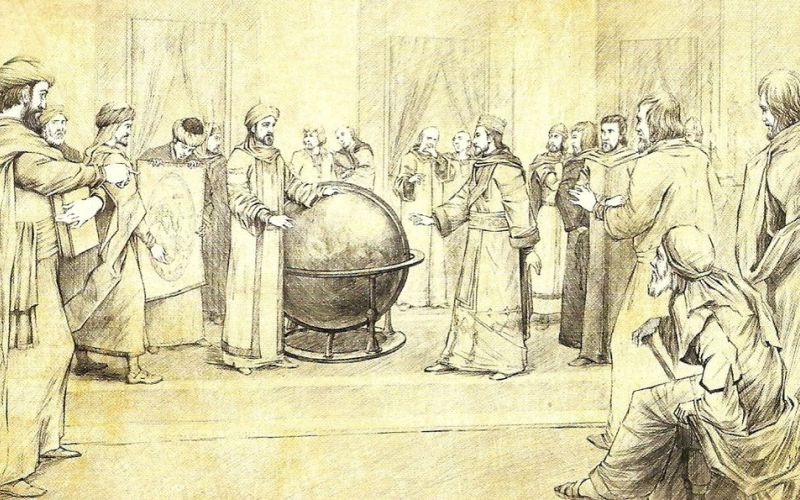
Peace be upon you, and welcome. How are you and how are things? I hope all is well and wish you goodness, health, and peace. Almost every day we discuss a different subject, although I am sorry that I sometimes cannot write. I would welcome your suggestions for a topic because choosing one can be difficult. Anyone who shares ideas with me is warmly welcome. Today I would like to discuss knowledge in the earlier Muslim world and people whose names were written in letters of gold.
Muslim scholars made many contributions across different fields and periods, each following interests in applied science, religion, language, philosophy, or society. Ibn Sina wrote The Canon of Medicine, which remained a fundamental medical reference for a long time. Ibn Khaldun was the first to discuss the science of civilization and is therefore regarded as a founder of modern sociology. In The Compendious Book on Calculation by Completion and Balancing, Al-Khwarizmi presented the first systematic solution of linear and quadratic equations and is considered the founder of algebra. Al-Idrisi distinguished himself in geography and cartography. Many others also became prominent, and their works were translated into Latin and other languages.
Caliphs who patronized knowledge and scholars included Harun Al-Rashid, Abu Al-Abbas Abdullah Al-Mamun, who considered himself a scholar, Al-Mutasim Billah, Al-Mutawakkil Ala Allah, Al-Hakim bi-Amr Allah, and others who supported scholarly work. The original introduction then announces a list of leading Muslim scholars arranged by specialization and chronology, but no list follows in the source.