
Many different types of concrete are available today because of their different ingredients. Examples include the following.
Concrete mortar: a mixture of pea gravel with sand-and-cement mortar. Concrete, also called beton: a mixture of natural gravel or crushed hard stone with clean sand free of impurities and very fine powder, combined with cement in technically established proportions. Plain concrete: also called blinding concrete; it is not used to cast load-bearing structures. It is usually poured to fill voids and stabilize soil beneath or around steel-reinforced structures.
Reinforced concrete: concrete cast with steel bars whose shapes are specified by specialist design engineers. The combination makes the cast element stronger and able to carry heavy loads, such as in bridges, roofs and tall buildings. White concrete: a mixture of white cement, sand and gravel. Broken-brick concrete: a mixture of crushed bricks with sand-and-cement mortar.
Other reinforced concretes have special properties and uses, including underwater-cast reinforced concrete, fire-resistant reinforced concrete, concrete resistant to atomic radiation, reinforced concrete for dams, bomb-resistant reinforced concrete, earthquake-resistant reinforced concrete, and colored reinforced concrete.
Different methods of preparing reinforced-concrete products give rise to other names:
In-situ concrete: cast at its final location; the cast element is not moved after pouring.
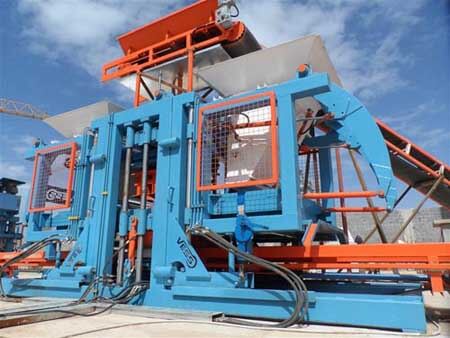
Precast concrete products: elements are cast and hardened in dedicated factories, then transported to the required site and assembled using connections.
Prestressed concrete: concrete is cast with very strong tensioned wires. The wires are cut after the concrete hardens so that the concrete can carry very large loads, as in very long bridges.