
A heavy legacy
Youth and Sports Minister Abdul-Hussein Abtan told Alsumaria News: “What we found when we took over the ministry was a heavy legacy in sports facilities and projects.” He said that, had he been in charge previously, he would have chosen to build one stadium in Baghdad rather than four that remained unfinished.
Abtan added that one stadium could have been built in a suitable location in Baghdad with a capacity of 60,000 spectators, and the same approach could have been followed in the provinces. He said the ministry’s current problem was the severe austerity it faced in line with state policy.
Abtan explained that the ministry would be able to complete only two stadiums during 2016: Maysan International Stadium and Karbala Olympic Stadium, with a capacity of 30,000 spectators.
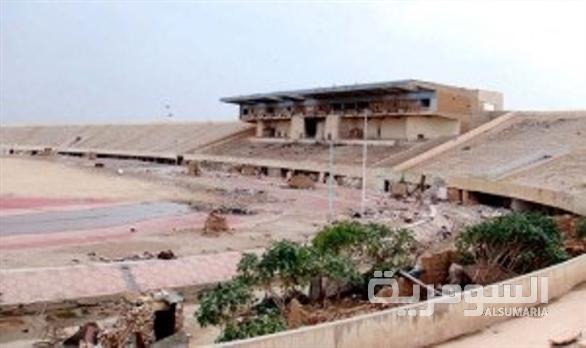
Maysan International Stadium is considered a model international stadium conforming to international specifications. Despite numerous reconstruction and rehabilitation campaigns, however, it was still unfit to host matches and activities. It also suffered damage when US forces, followed by Iraqi armed forces, were stationed there in previous years.
Companies without the necessary specialization
Khalid Kubayyan, head of the Olympic Committee’s Maysan representative office, said work on Maysan Stadium remained delayed and much still needed to be done before it could host matches. He attributed the delays to awarding the project to a company without the necessary specialization that had previously been responsible for stalled projects in Maysan.
Kubayyan said three companies had submitted bids, but the ministry accepted a bid of 36.5 billion from a Turkish company that was not qualified. The stadium remained unfinished. He said the current ministry had stressed that the playing field should be completed first, followed by the covering or roof.
He explained that the roof required substantial money, effort and more time, and expressed hope that the playing surface could be completed within three months so the stadium would be ready for matches.
Yahya Zghair, a member of the central football association and president of Naft Maysan Club, expressed his dissatisfaction and frustration at the condition of the stadium, which he described as the province’s most important and only facility of its kind. He said the delay in completing the project had harmed the province’s clubs because of the shortage of stadiums.
Zghair called on the Ministry of Youth and Sports to give the stadium attention and complete its rehabilitation and reconstruction so the province and its clubs could benefit from the project.
Salah al-Din Stadium and a story of failure
The sports city planned for Salah al-Din province had seen no progress. Work was not merely delayed but had stopped completely for several reasons, including the security situation and disagreements over the stadium’s location.
Mohammed Khalil, head of the Olympic Committee’s representative office and the local football association, said the Salah al-Din sports city was a major and important project that had been planned for the city center, opposite Tikrit University, on an area of approximately 250 dunams.
Khalil told Alsumaria News that the previous Ministry of Youth and Sports had awarded the project to a Turkish company and selected a site, but no actual steps had been taken to implement it. He said some contractors working on the project had agreed to pay ISIS a share of the money periodically, before the group emerged openly in Iraq.
He continued that matters worsened when ISIS gangs kidnapped and executed approximately 16 project workers, causing work to stop and the project to be abandoned. He said this enabled the provincial council and the Youth and Sports Directorate to move the proposed site to al-Alam district on the grounds that it was safer than the provincial center.
Khalil said former Youth and Sports Minister Jasim Mohammed Jaafar approved the move despite their objections, as a project of this scale should be in the provincial center rather than in a district or subdistrict.
He added that the project had been approved during the financial boom under the previous ministry, with approximately 103 billion Iraqi dinars allocated to it. He called for it to be returned to the land originally designated in the provincial center, particularly now that security there had stabilized.
For his part, provincial Youth and Sports Director Jawad Najm told Alsumaria News that al-Alam’s security was why they had requested the move there, especially after former minister Jasim Mohammed Jaafar al-Bayati had proposed moving the project to Kirkuk province.
Najm said the directorate rejected that proposal and asked the ministry to build the stadium in al-Alam, particularly after obtaining approvals from the municipality and provincial council, which allocated 165 dunams. He said work had actually begun, with a resident engineer’s office established and a fence erected around the site.
Jawad added that the old stadium site lacked full protection because it was in an open area connecting the city to the highway leading to Ramadi. Local officials and the directorate approached the province’s parliamentary representatives and secured approval within 15 days to establish the project in al-Alam, one of the province’s safest and most stable areas.
Jawad said the Italian company newly awarded the project had received an operating advance equal to 10% of the project’s estimated 103 billion cost. He said the company was willing to undertake the project on deferred payment and had the financial capacity to proceed. The proposal had been presented, but required an exemption from the Council of Ministers.
The Salah al-Din sports city project includes a 30,000-seat stadium, two training grounds accommodating 200 and 500 spectators, a four-star hotel, car parks and other facilities.