
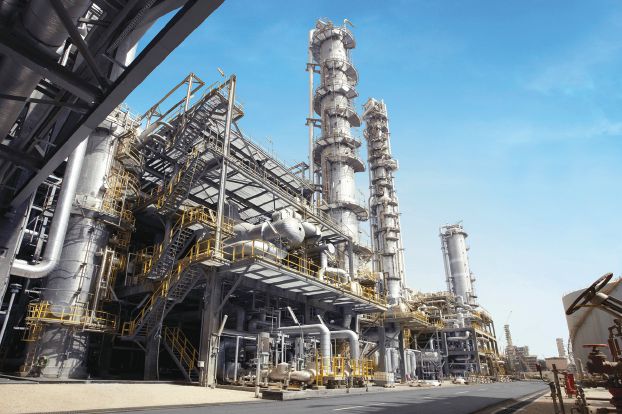
Prince Turki bin Saud bin Mohammed, president of King Abdulaziz City for Science and Technology, said yesterday that Saudi Arabia continued to invest in petrochemicals through joint efforts by the state and private sector. These would raise annual production capacity to around 100 million metric tons, equivalent to 10 percent of global output, making the kingdom the world’s third-largest petrochemical exporter that year.
Opening the Third Saudi International Petrochemical Technologies Conference at the city’s headquarters in Riyadh, he said Saudi Arabia was building huge petrochemical complexes in Jubail and Yanbu industrial cities, among the largest of their kind worldwide. Unprecedented facilities for the private sector would help petrochemicals add value and diversify national income.
He highlighted Saudi Aramco’s vital role in establishing advanced petrochemical industries through the creation of Sadara, described as the world’s largest industrial complex producing more than 64 million metric tons of various petrochemicals. He added that competition was fierce among countries, led by the United States, to produce petrochemicals from shale gas and associated and non-associated natural gas.
Petroleum and Mineral Resources Minister Ali Al-Naimi said the ministry’s strategy included optimal energy use, maximizing the benefits of hydrocarbon and mineral resources, and achieving the greatest added value for the economy when allocating fuel and feedstock to companies and relevant bodies. This would support economic growth and diversification and create worthwhile jobs for citizens.
“With fuel, feedstock, and infrastructure available, Saudi petrochemicals are experiencing the largest growth in their history,” he said. Total production of petrochemicals, chemicals, and polymers would exceed 115 million tons by the end of 2016, a 250 percent increase since 2006. Ethylene production would rise by more than 230 percent and propylene by more than 300 percent; both are basic petrochemical inputs.
He expected total investment in petrochemical plants from their establishment through 2016 to reach about $150 billion. This had led to dozens of petrochemical companies, including 14 listed on the Saudi stock market, with more to follow. Among the most significant was SABIC, one of the world’s largest and most important petrochemical companies.
He said Saudi strategy was to establish integrated refineries that did more than refine crude oil and extract its principal products. They would produce a variety of petrochemicals for interconnected domestic manufacturing processes through to finished products, while attracting Saudi and international private investment in final-product manufacturing.
He identified four main projects: Petro Rabigh, a partnership between Saudi Aramco and Japan’s Sumitomo; SATORP in Jubail, between Saudi Aramco and France’s Total; Sadara Chemical Company in Jubail, between Saudi Aramco and the US company Dow; and the Jazan refinery and its associated industrial complex.
In addition, the ministry had established Industrialization and Energy Services Company, TAQA, and entrusted its operation to the private sector. It had developed gradually and provided services in exploration, drilling, and raw-material manufacturing along the energy industry supply chain. One of its leading recent projects was JESCO in Jubail, manufacturing seamless pipes for all applications to serve domestic and regional markets and export to many countries.
Al-Naimi added that the ministry, working with government agencies and national companies, had established Ras Al-Khair on the Arabian Gulf. It was the kingdom’s third most important industrial city and its first for mining industries. Its projects, some already producing, included an integrated mining system with an alumina refinery, aluminum smelter, related downstream industries, and a complex for processing phosphate and producing various fertilizers.
He said the ministry and several government agencies had also established the King Abdullah project to develop Waad Al-Shamal, whose construction contracts were launched early that year. It would develop mining and related manufacturing in northern Saudi Arabia and support sustainable development in the Northern Borders region.
Meanwhile, international benchmark Brent crude held above $66, near its highest level since the beginning of the year, after protesters closed the Zueitina oil port in eastern Libya, disrupting crude exports. Zueitina was one of the few Libyan oil ports still exporting, as others had been closed by fighting or field disruptions since the overthrow of Muammar Gaddafi. Officials said Libya’s production was below 500,000 barrels a day, one third of its pre-2010 level.
A stronger dollar also pressured oil by making commodities more expensive for holders of other currencies. Brent rose 10 cents to $66.55 a barrel after touching an intraday high for the year of $67.10 the day before yesterday. US crude gained five cents to $58.98.