
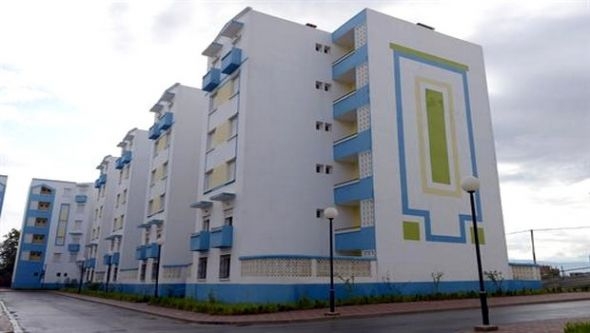
The housing sector is a driving force within the executive branch. Some 93% of its planned projects have been completed or started, with the remainder still to come.
The sector received substantial support in 2015, and the difference compared with previous years is clear. It ranked first in implementing the five-year program that the executive branch was assigned to manage and monitor. According to official figures, nearly 93% of its projects were completed or launched under the 3-million-home program, with projects covering only 87,000 units yet to start.
Housing is a central concern for the Algerian government and society. Following AADL 2, the Housing Ministry’s websites recorded the highest visitor numbers, reflecting strong public interest. Algerians viewed the program as a way out of their housing crisis, with the main priority being a stable home, wherever it was located.
A review of 2015 indicated that the housing, urban planning and city sector was approaching the elimination of Algeria’s housing crisis. The deficit had fallen to 450,000 units from 3 million at the beginning of the millennium.
More Than 273,000 Homes Delivered in 2015
More than 273,000 housing units were delivered during 2015, a pace comparable with each of the previous two years. The ministry’s figures included 102,956 public rental or social housing units, 28,891 subsidized promotional housing units, and 142,700 rural homes.
Work also began on 312,519 homes during 2015, including 67,955 rural homes and 44,745 public rental homes. Expenditure reached 548 billion dinars, with social housing accounting for 59%. The report also recorded approval of 1,667 project revaluations covering 303,660 homes at a cost of 48 billion Algerian dinars.
At the meeting reviewing the sector’s 2015 performance, the minister said: “We are very close to eliminating the housing crisis; only a deficit of 450,000 units remains.” This corresponded to applications that had remained unmet for more than five years. Once the crisis was resolved, the sector would only need to manage new demand arising annually in the property market.
AADL Applicants’ Protests
The year also saw protests involving every housing scheme: LPP public promotional housing, AADL 1 and 2, and social housing. Protests, sit-ins and gatherings occurred repeatedly, especially outside the AADL agency in Said Hamdine.
A central demand was a definitive solution for 2001–2002 AADL applicants aged over 70 who had waited about 13 years. Reports had circulated that they might be denied homes because of their age.
AADL 1 Allocation Decisions and AADL 2 Site Selection
In 2015, it was announced that AADL 1 applicants would receive allocation decisions on February 8, while AADL 2 applicants would select housing sites on March 11, 2016. The sector described preliminary allocation decisions as documents proving an applicant’s ownership of a home, to be converted into a legally valid housing contract.
Electronic site selection for AADL 2 was scheduled for March 11, 2016, with preliminary allocation decisions to be distributed on May 30 of the same year.
Regarding subsidized participatory housing, Housing Minister Abdelmadjid Tebboune had previously said a ministry committee conducted a comprehensive survey of projects in that scheme. It found 8,000 construction projects still under way, including 2,800 sites that had stopped completely.
A special committee was examining beneficiaries’ files and was expected to finish at the beginning of the following month. Depending on its decisions, beneficiaries would either move to the AADL program or see their construction sites restarted and assigned to private companies.
For public promotional housing, Tebboune said the process was continuing and preliminary allocation decisions would begin to be distributed at the end of December and the beginning of January. Only 12,000 of 46,000 applicants had paid the second installment, indicating that those who had not paid had abandoned participation in that scheme.
Challenges of 2015
In 2016, the housing, urban planning and city sector expected the private sector’s role to grow as public programs gradually decreased and focused mainly on low-income groups.
To improve local management, the minister had recently issued three circulars. They required negotiations with companies to be conducted collectively, avoiding closed individual meetings; separated tenders for studies from those for construction; and prohibited combining small projects into one project to award it to a contractor from a shortlist.
He instructed officials to resolve problems at stalled social-housing sites before the end of the first half of 2016, the same deadline set for regularizing the status of public-housing projects.
He also called for better communication with citizens to speed up sales of rental homes delivered before 2004, saying: “It is unreasonable for citizens to refuse to buy their homes when they are offered at a nominal price.”
Tebboune gave officials two months to resolve problems obstructing the rural-housing program. He said administrative measures intended to make matters easier had failed to improve the situation because of “crippling bureaucracy.”