
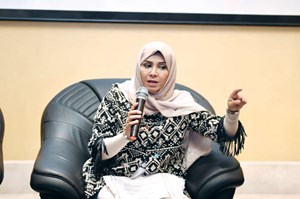
The Director-General of the General Authority for the Affairs of People with Disabilities, Dr. Tariq Al-Shatti, affirmed the commitment to achieving social inclusion and a decent life for people with disabilities through their full participation in sustainable development based on fairness, justice, and equality. He pointed out that the authority seeks to promote the rights-based model of disability by planning, formulating policies, coordinating, and supporting all activities aimed at serving people with disabilities, adopting a community participation, accountability, and transparency approach.
This was stated in his speech the evening before yesterday on the sidelines of the lecture organized by the Kuwaiti Association for Parents of People with Disabilities as part of its 2015/2016 cultural season, entitled "Comprehensive Integration of People with Disabilities: Education, Employment, and Community," with the presence of a number of state institutions and entities concerned with implementing the law on people with disabilities.
Al-Shatti added that the authority, during the past months, coordinated with the General Secretariat of the Supreme Council for Planning and Development and the Ministry of Finance to include eight of the authority's projects within the current development plan, emphasizing that more than six of these projects aim to achieve the authority's strategic vision of reaching comprehensive integration, and they are classified as development projects. He pointed out that among these projects are the "Educational, Economic, and Community Integration of People with Disabilities" project, the "Implementation of the Universal Design" project, and the "Establishment of a Distinguished Center for Medical Rehabilitation with an Advanced Model for Home-Based Medical Rehabilitation," in addition to implementing a system of technological aids and expanding and developing the housing and care system, and a project to develop the transportation system.
Al-Shatti also addressed the concept of the legal framework for integration, which is based on the provisions of Law No. 8 of 2010, under which the authority was established, and which includes the obligations of the government and civil society to ensure the full integration of people, as well as their integration into society in accordance with Chapter Five of the law. He referred to Article 18, which concerns the obligation of the Youth and Sports Authority to establish clubs and centers for sports, recreational, and cultural activities in accordance with international standards for people with disabilities in all governorates, with the aim of integrating them into society.
On another note, Al-Shatti indicated that the project to automate the General Authority for the Affairs of People with Disabilities has been slightly delayed, but within two weeks, the contract for it will be signed, in addition to the electronic portal, the establishment of a database, and a dedicated hotline for the authority.
Rehabilitation Certificates
For her part, the President of the Kuwaiti Association for Parents of People with Disabilities, Rehab Boursali, pointed out that the concept of comprehensive integration of people with disabilities into society requires a real and practical approach, not just theoretical discussions. She pointed out the need to find solutions to many problems so that we can implement educational integration for this dear segment of our society, especially with regard to the Down syndrome category, as the Ministry of Education teaches this category up to the fifth grade, in addition to the end of the ministry's role in achieving educational integration for slow learners in the ninth grade, as if it is not concerned with these categories of people with disabilities.
She also affirmed that Kuwait only lacks good management that seeks to find comprehensive solutions from all concerned parties, including government agencies and civil society organizations, noting that the responsibility does not fall solely on the General Authority for the Affairs of People with Disabilities.
Boursali expressed her surprise at the Civil Service Bureau’s handling of certificates for people with disabilities, considering them as qualifying certificates rather than academic certificates, and therefore not accepting their employment. She pointed out that the Ministry of Education’s equivalence of the certificate for people with intellectual disabilities creates a kind of discrimination against people with disabilities, noting that they study for 15 years to obtain a certificate that is not recognized and is supposed to be equivalent to a high school diploma, as if they are being punished for their disability, as this certificate is a stigma for them and does not guarantee them a job in a prestigious position, while in other countries, their certificates, whether academic or qualifying, are recognized as a high school diploma. She hopes that the General Authority for the Affairs of People with Disabilities will reach an agreement with the Ministry of Education to make the certificate for people with intellectual disabilities equivalent to a high school diploma and not to be labeled as a qualifying certificate so that they do not become a burden on society.
In a related context, Rateb Al-Arifaan, Director of the Selection Department at the Civil Service Bureau, confirmed the coordination between the Civil Service Bureau and the General Authority for the Affairs of People with Disabilities in employing people with disabilities, explaining that any applicant for registration with the Bureau must go to the Disability Authority and bring a letter from the Rehabilitation and Employment Department in addition to proving their disability, so that the Bureau can provide them with a suitable job opportunity.
He pointed out that the Bureau took the initiative to obtain approval to open the registration period for several years and to approve the registration of people with disabilities throughout the year without waiting. He noted that the Bureau, represented by the Relations and Selection Department, took the initiative to register people with disabilities, and it also has specialists in registering applications for people with disabilities automatically and distributing them according to their specialties, noting that since the beginning of the implementation of centralized employment in 1999 until now, 1616 people with disabilities have been appointed in various government agencies, ministries, and departments.
He presented a table on the salaries of people with disabilities according to their certificates and academic qualifications, where 679 dinars are paid to married people with intermediate certificates, while single people with intermediate certificates receive 598 dinars, which are equal to the salaries paid by the government.
Inclusive education.
For his part, Dr. Issa Al-Jassem, a consultant at the Child Assessment and Education Center, stated that comprehensive integration can only be achieved through educational integration, by educating students with disabilities in mainstream schools alongside their peers without disabilities, but through multiple stages, so that they are accepted in classrooms through special rehabilitation programs without the disabled student feeling alienated from their peers. He emphasized that this should start from kindergarten and continue through university, so that disability is not seen as a complex issue but rather as a talent and a blessing from God that can benefit the country. He stressed that without educational integration, it is impossible to talk about comprehensive integration of the disabled in society. He cited the implementation of a short experiment in 2010 and 2011 on 26 schools in the Mubarak Al-Kabeer area in cooperation with the General Secretariat of Endowments regarding students with learning difficulties, to introduce the concept of quality in educational integration as a virtual experiment on how teachers and students deal with their disabled peers from all different disabilities. He pointed out that the results of that experiment showed the ability of Kuwaiti schools to apply the standards of educational integration for people with disabilities and gradually open their doors to them, so that they can accommodate the most difficult disabilities through a dedicated class for the disabled or a dedicated teacher for the disabled.