
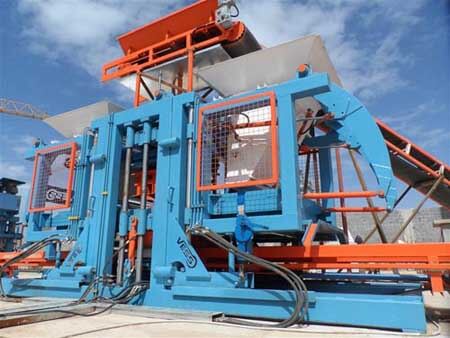
After the sand and gravel have been cleaned, they are stored in a suitable place on site, away from moisture. Small quantities of concrete are mixed by hand using a shovel.
For the commonly used method of hand mixing larger quantities, 2 batch boxes of gravel or crushed stone are combined with 1 batch box of sand and the required number of cement bags. These ingredients are dry-mixed 3 times on a solid, level platform made from wooden boards or a similar material, using a braced shovel. Once the mix has a uniform color, water is added gradually in the required quantity. Turning and mixing continue for 3 passes until the color and consistency are uniform.
Several regional engineering terms are used here. Gravel is called “zalat” in Egyptian Arabic, “sharshur” in Libyan Arabic, “hasu” in Iraqi Arabic and “bahs” in Syrian Arabic. A cement bag is called “kis al-asment” in Iraq and Jordan, while “shikara” is used in Egypt and has a standard weight of 50 kg.
Concrete ingredients may be dry-mixed in a central mixer as in central mixing, while the water is mixed into the concrete in the mixer truck, either on the way to the job site or immediately before pouring. This gives more time for transport. Its disadvantage is that the mixer truck’s capacity is usually about three-quarters of that of a ready-mix concrete transport truck because mixing the ingredients with water reduces their volume.
The concrete should be agitated during transport at a speed of 2–6 revolutions per minute to maintain its consistency.