
Articles in English
Peace be upon you. Today I thought we could read about English and compare it with Arabic. As you know, both languages are used by many people in different countries, and interest in them grows daily. Technological development has made learning much easier, although effort is still needed. Let us read this language lesson.
Indefinite Articles: A and An
Nouns are either countable, such as boys, horses, and girls, or uncountable, such as sugar, butter, tea, and milk. The articles a and an are therefore used only with singular countable nouns. An is used before a vowel sound, including words beginning with a silent h. A is used before other consonant sounds.
Examples: an egg, an apple, an umbrella, an orange, an hour; a doctor, a nurse, a book, a computer.
Uncountable nouns do not take the articles a or an. Examples:
- I can’t drink tea without sugar.
- We eat cheese and butter in the morning.
Uses of the Article A
- Before a singular countable noun first mentioned in a text. On its second mention, use the: “There is a policeman at the door. The policeman needs some information.” Policeman is singular and countable. A first means an unspecified policeman; the second mention refers to that particular officer.
- Before a singular countable noun used as an unspecified example of a class: “A car must be insured” means any car, not a particular one. “A child needs love” means any child, not a specific child.
- With occupations when a name or pronoun begins the sentence: “Ahmad is a doctor.” “She is a teacher.” “Rami became a pilot.”
- In fixed numerical expressions: a couple (two), a dozen (twelve), a great deal of, a lot of, a bunch of, a great many, a quarter, a hundred, and a bit. Examples: “He has a great many friends.” “She has bought a dozen of pencils.”
- In expressions of speed, prices, and numerical rates: 5 JD a kilo, 1 JD a metre, and a percentage of.
- With a few and a little, both expressing a small amount or number.
An follows the same uses as a, but appears before vowel sounds or a silent h. An adjective beginning with a vowel sound may come before the noun, as in “an ancient castle.”
Definite Article: The
The is used with countable and uncountable nouns, singular and plural: the boy, the boys, the girl, the girls, the day, the days.
Uses of the Article The
- When the intended person or thing is clear and specific: “Can you turn off the light?” refers to a particular light. “I took a taxi to the station” refers to a particular station. Similarly, we can say the floor, the ceiling, the door, the police, the bank, the post office, the airport, and the window when the referent is known.
- On a noun’s second mention, as explained for the article a: “They live in a small house. The house was very ancient.” House first takes a, then the because it has become definite.
- For things treated as unique. The lesson lists the earth, the sky, the weather, the sun, the north pole, the moon, the stars, the wind, the king, and the queen. Examples: “The sun rises in the east.” “The sky is far away from the earth.”
- With nouns followed by a phrase or clause identifying them, including clauses introduced by who, which, where, whom, or that: “The man on the donkey.” “The girl in blue.” “I saw the horse which my father sold last week.” “Do you like the coffee we had with our meal last night?” The donkey, blue clothing, and relative clauses identify the particular people or things.
- With adjectives used as plural nouns referring to everyone sharing a characteristic: the young, the old, the strong, the rich, the poor, the blind, the homeless, the deaf, the disabled, the unemployed, and the dead. “The young are impatient. They want changes.” Here young is used as a noun meaning young people generally.
- With compass directions—the east, west, north, and south—when followed by of or used as nouns: “I went to the south of Jordan last year.” “The north is more beautiful than the south.”
- Before a singular animal or thing representing a whole class: “The lion is in danger of being extinct.” “The mobile phone has made life easier.” These mean lions and mobile phones generally, not one particular example.
- With musical instruments after play: the drum, the piano, the guitar, and the flute. Examples: “She learnt to play the flute.” The second source example reads: “My is going to play the piano in the concert.”
- With superlatives ending in -est, such as oldest, shortest, longest, cleverest, warmest, and hottest, or using most, such as the most dangerous and the most interesting. Also with ordinal numbers: the first, second, third, and so on. Examples: “Mount Everest is the highest mountain in the world.” “The tiger is the most dangerous animal.” “Saturday is the first day of the week.”
- Before the categories and names listed below.
- With these times after in: in the morning, in the afternoon, and in the evening. Examples: “They will arrive in the morning.” “My mother is going to see the doctor in the afternoon.”
Names Listed with The in the Original Lesson
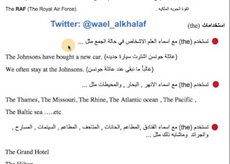
- Seas: the Dead Sea and the Red Sea.
- Oceans: the Indian Ocean and the Pacific.
- Rivers: the Nile and the Jordan River.
- Deserts: the Sahara and the Nofoudh.
- Mountain ranges: the Alps and the Himalayas.
- Island groups: the Canaries and the Maldives.
- Political country names and names formed with noun + of + noun: the Hashemite Kingdom of Jordan, the Republic of France, the United States of America, the Union of South Africa, the Cape of Good Hope, and the Gulf of Mexico.
- Other expressions: the Holy Land, the Eiffel Tower, the world, and the mosque.
- Nationalities used adjectivally, as presented in the source: the Jordanian and the Egyptian.
- Selected geographical names: the Sudan, the Yemen, the Congo, the Hague, the Netherlands, the Philippines, and the Ivory Coast.
- The cinema, the theatre, and the radio.
Omission of Articles: X
The article is omitted in the following cases:
- With personal names and geographical country names except the cases already listed: Ahmad, Rami, Laila, Jordan, Egypt, and America. Do not say “the Ahmad,” “the Rami,” “the Laila,” “the Jordan,” or “the Egypt.”
- With uncountable nouns and plural countable nouns when speaking generally: “I don’t like tea” means tea generally; “I love flowers” means flowers generally.
- With the main meals: breakfast, lunch, and dinner.
- The source presents the pattern to + noun + to with prison, court, hospital, school, college, market, church, and bed. Examples: “I go to school to study.” “I go to hospital to see the doctor.”
- With sports: football, volleyball, basketball, tennis, and so on.
- With days and months: Saturday, Sunday, January, and so on.
- With lakes, continents, cities, individual islands, individual mountains, and languages, as listed below.
- With these time expressions: at night, sunrise, sunset, dawn, and midnight.
- With transport following by, such as by car and by bus, or in on foot.
Examples for item 7: Lake Superior and Lake Constance; Africa, Asia, and Europe; Amman, London, and Damascus; Bermuda and Cyprus; Mount Everest; English, French, and Arabic.
Comprehensive Article Exercises
Choose the most suitable answer. X means no article. The exercise content follows the original lesson.
- I will watch the CD at … night. (a / an / the / x)
- … apple tree we watered yesterday is beautiful. (A / An / The / x)
- My father is … actor. (a / an / the / x)
- I like … oranges which grow in Jordan. (a / an / the / x)
- … American tiger which I saw in the zoo is an interesting animal. (A / An / The / x)
- My friend works as a translator at … United Nations. (a / an / the / x)
- … art gallery which Ahmad visited was amazing. (A / An / The / x)
- For … lunch I had a sandwich and an apple. (a / an / the / x)
- This morning I bought … newspaper. The newspaper is in my bag. (a / an / the / x)
- I must go to … Bank of Jordan to change some money. (a / an / the / x)
- It was getting dark in the room, so I turned on … light. (a / an / the / x)
- I will take an exam on … Saturday. (a / an / the / x)
- It was … best film I have ever seen. (a / an / the / x)
- Braille is a system of reading and writing for … blind. (a / an / the / x)
- … rice doesn’t grow in Jordan. (a / an / x)
- Are … English people you know friendly? (a / an / the / x)
- I want to go to … college to study there. (a / an / the / x)
- … Amazon River flows in … Pacific Ocean. (A / An / The / x)
- … Africa is much larger than … Europe. (A / An / The / x)
- I would like to buy … dozen of notebooks. (a / an / the / x)
- … sky is red and … sun is just setting. (a / an / the / x)
- … London is in Britain. (a / an / the / x)
- He plays … piano well. (a / an / the / x)
- … old car crashed into a wall. The driver of the car wasn’t hurt. (A / An / The / x)
- Friday was … hottest day in the week. (a / an / the / x)
- In cold countries, … water freezes when you leave it for an hour. (a / an / x)
- … ostrich is the largest living bird. (A / An / The / x)