
Les articles en anglais
Paix sur vous. Aujourd’hui, je propose de découvrir l’anglais et de le comparer à l’arabe. Ces deux langues sont utilisées dans de nombreux pays et suscitent un intérêt croissant. La technologie facilite l’apprentissage, qui demande toujours des efforts. Lisons cette leçon.
Les articles indéfinis : A et An
Les noms peuvent être dénombrables, comme boys, horses et girls, ou indénombrables, comme sugar, butter, tea et milk. Les articles a et an s’emploient donc seulement avec des noms dénombrables singuliers. An précède un son vocalique, y compris après un h muet ; a s’utilise devant les autres sons consonantiques.
Exemples : an egg, an apple, an umbrella, an orange, an hour ; a doctor, a nurse, a book, a computer.
Les noms indénombrables ne prennent pas les articles a et an. Exemples :
- I can’t drink tea without sugar.
- We eat cheese and butter in the morning.
Emplois de l’article A
- Devant un nom dénombrable singulier mentionné pour la première fois. À la deuxième mention, on emploie the : « There is a policeman at the door. The policeman needs some information. » Policeman est singulier et dénombrable. A désigne d’abord un policier non précisé ; the renvoie ensuite à ce policier particulier.
- Devant un nom singulier représentant un exemple non précisé d’une catégorie : « A car must be insured » concerne toute voiture, et « A child needs love » tout enfant, sans en désigner un en particulier.
- Avec les professions lorsque la phrase commence par un nom ou un pronom : « Ahmad is a doctor. » « She is a teacher. » « Rami became a pilot. »
- Dans des expressions numériques fixes : a couple (deux), a dozen (douze), a great deal of, a lot of, a bunch of, a great many, a quarter, a hundred et a bit. Exemples : « He has a great many friends. » « She has bought a dozen of pencils. »
- Dans les expressions de vitesse, de prix et de taux : 5 JD a kilo, 1 JD a metre et a percentage of.
- Avec a few et a little, qui expriment une petite quantité ou un petit nombre.
An suit les mêmes règles que a, mais précède un son vocalique ou un h muet. Un adjectif commençant par une voyelle sonore peut précéder le nom : « an ancient castle ».
L’article défini : The
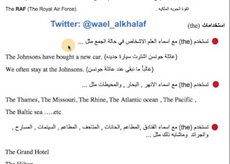
The s’emploie avec les noms dénombrables et indénombrables, au singulier et au pluriel : the boy, the boys, the girl, the girls, the day, the days.
Emplois de l’article The
- Lorsque la personne ou la chose visée est précise et connue : « Can you turn off the light? » désigne une lumière particulière ; « I took a taxi to the station » une gare déterminée. On dit de même the floor, the ceiling, the door, the police, the bank, the post office, the airport et the window lorsque le référent est connu.
- À la deuxième mention d’un nom, comme pour l’article a : « They live in a small house. The house was very ancient. » House prend d’abord a, puis the une fois défini.
- Pour les éléments considérés comme uniques. La leçon cite the earth, the sky, the weather, the sun, the north pole, the moon, the stars, the wind, the king et the queen. Exemples : « The sun rises in the east. » « The sky is far away from the earth. »
- Avec un nom suivi d’une expression ou d’une proposition qui l’identifie, notamment avec who, which, where, whom ou that : « The man on the donkey. » « The girl in blue. » « I saw the horse which my father sold last week. » « Do you like the coffee we had with our meal last night? » L’âne, les vêtements bleus et les propositions relatives identifient précisément les personnes ou les choses.
- Avec des adjectifs employés comme noms pluriels désignant toutes les personnes d’une catégorie : the young, the old, the strong, the rich, the poor, the blind, the homeless, the deaf, the disabled, the unemployed et the dead. « The young are impatient. They want changes. » Young signifie ici les jeunes en général.
- Avec les points cardinaux, the east, west, north et south, suivis de of ou employés comme noms : « I went to the south of Jordan last year. » « The north is more beautiful than the south. »
- Devant un animal ou une chose au singulier représentant toute une catégorie : « The lion is in danger of being extinct. » « The mobile phone has made life easier. » Il s’agit des lions et des téléphones en général.
- Avec les instruments après play : the drum, the piano, the guitar et the flute. Exemple : « She learnt to play the flute. » Le deuxième exemple de la source est : « My is going to play the piano in the concert. »
- Avec les superlatifs en -est, comme oldest, shortest, longest, cleverest, warmest et hottest, ou construits avec most, comme the most dangerous et the most interesting. Également avec les ordinaux : the first, second, third, etc. Exemples : « Mount Everest is the highest mountain in the world. » « The tiger is the most dangerous animal. » « Saturday is the first day of the week. »
- Devant les catégories et les noms énumérés ci-dessous.
- Dans ces expressions après in : in the morning, in the afternoon et in the evening. Exemples : « They will arrive in the morning. » « My mother is going to see the doctor in the afternoon. »
Noms présentés avec The dans la leçon originale
- Mers : the Dead Sea et the Red Sea.
- Océans : the Indian Ocean et the Pacific.
- Fleuves : the Nile et the Jordan River.
- Déserts : the Sahara et the Nofoudh.
- Chaînes de montagnes : the Alps et the Himalayas.
- Archipels : the Canaries et the Maldives.
- Noms politiques de pays et noms construits avec nom + of + nom : the Hashemite Kingdom of Jordan, the Republic of France, the United States of America, the Union of South Africa, the Cape of Good Hope et the Gulf of Mexico.
- Autres expressions : the Holy Land, the Eiffel Tower, the world et the mosque.
- Nationalités employées comme adjectifs, telles que présentées dans la source : the Jordanian et the Egyptian.
- Certains noms géographiques : the Sudan, the Yemen, the Congo, the Hague, the Netherlands, the Philippines et the Ivory Coast.
- The cinema, the theatre et the radio.
Absence d’article : X
L’article est omis dans les cas suivants :
- Avec les noms de personnes et les noms géographiques de pays, sauf exceptions déjà citées : Ahmad, Rami, Laila, Jordan, Egypt et America. On ne dit pas « the Ahmad », « the Rami », « the Laila », « the Jordan » ou « the Egypt ».
- Avec les noms indénombrables et les noms dénombrables pluriels employés en général : « I don’t like tea » et « I love flowers » parlent du thé et des fleurs en général.
- Avec les repas principaux : breakfast, lunch et dinner.
- La source présente la construction to + nom + to avec prison, court, hospital, school, college, market, church et bed. Exemples : « I go to school to study. » « I go to hospital to see the doctor. »
- Avec les sports : football, volleyball, basketball, tennis, etc.
- Avec les jours et les mois : Saturday, Sunday, January, etc.
- Avec les lacs, continents, villes, îles individuelles, montagnes individuelles et langues, comme ci-dessous.
- Dans ces expressions temporelles : at night, sunrise, sunset, dawn et midnight.
- Avec un moyen de transport après by, comme by car et by bus, ou dans on foot.
Exemples du point 7 : Lake Superior et Lake Constance ; Africa, Asia et Europe ; Amman, London et Damascus ; Bermuda et Cyprus ; Mount Everest ; English, French et Arabic.
Exercices récapitulatifs sur les articles
Choisissez la réponse la plus adaptée. X signifie qu’il n’y a pas d’article. Le contenu des exercices suit la leçon originale.
- I will watch the CD at … night. (a / an / the / x)
- … apple tree we watered yesterday is beautiful. (A / An / The / x)
- My father is … actor. (a / an / the / x)
- I like … oranges which grow in Jordan. (a / an / the / x)
- … American tiger which I saw in the zoo is an interesting animal. (A / An / The / x)
- My friend works as a translator at … United Nations. (a / an / the / x)
- … art gallery which Ahmad visited was amazing. (A / An / The / x)
- For … lunch I had a sandwich and an apple. (a / an / the / x)
- This morning I bought … newspaper. The newspaper is in my bag. (a / an / the / x)
- I must go to … Bank of Jordan to change some money. (a / an / the / x)
- It was getting dark in the room, so I turned on … light. (a / an / the / x)
- I will take an exam on … Saturday. (a / an / the / x)
- It was … best film I have ever seen. (a / an / the / x)
- Braille is a system of reading and writing for … blind. (a / an / the / x)
- … rice doesn’t grow in Jordan. (a / an / x)
- Are … English people you know friendly? (a / an / the / x)
- I want to go to … college to study there. (a / an / the / x)
- … Amazon River flows in … Pacific Ocean. (A / An / The / x)
- … Africa is much larger than … Europe. (A / An / The / x)
- I would like to buy … dozen of notebooks. (a / an / the / x)
- … sky is red and … sun is just setting. (a / an / the / x)
- … London is in Britain. (a / an / the / x)
- He plays … piano well. (a / an / the / x)
- … old car crashed into a wall. The driver of the car wasn’t hurt. (A / An / The / x)
- Friday was … hottest day in the week. (a / an / the / x)
- In cold countries, … water freezes when you leave it for an hour. (a / an / x)
- … ostrich is the largest living bird. (A / An / The / x)